MK6 Seismic Shutoff — Electronic Earthquake Trigger
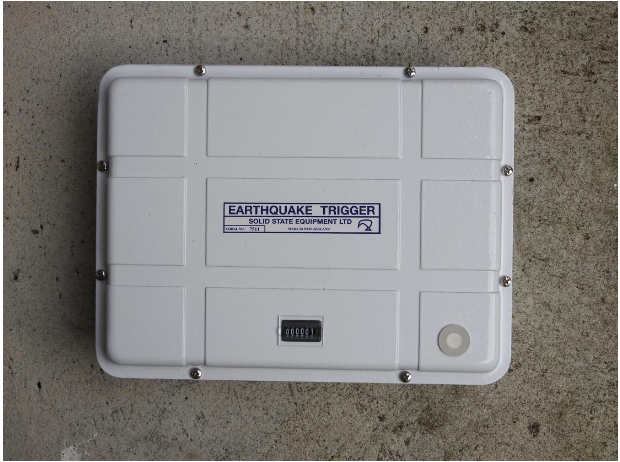
The MK6 is New Zealand’s trusted electronic earthquake trigger recorder — designed and manufactured by Solid State Equipment since 1971. Where passive mechanical seismic valves wait for physical displacement, the MK6 actively monitors ground acceleration around the clock, detecting the early P-waves that precede destructive shaking by precious seconds.
When the pre-set acceleration threshold is crossed, the MK6 fires its output relay within 10 milliseconds — closing gas valves, shutting down machinery, or triggering any connected safety system before the damaging S-waves arrive.
Key Features
Applications
Specifications
| Power | AC: 230 V, 50 Hz (NiCad backup, 24 hr) | DC: 12, 24, 110, or 230 V DC from a no-break supply |
| Sensitivity | 0.012 – 0.200g, field-adjustable (5 settings) |
| Response Time | Relay fires within 10 ms of threshold exceedance |
| Contact Rating | 10 A at 230 VAC | 3 A at 24 V DC |
| Construction | Cast aluminium, 290 × 220 mm base, 3 kg |
How the MK6 earthquake trigger works
An earthquake sends out two kinds of wave. The pressure wave (P-wave) travels fastest and arrives first. The shear wave (S-wave) follows seconds later — and does almost all of the damage. The MK6 continuously monitors ground acceleration in every direction and is designed to pick up the P-wave. More on P-wave detection and why those seconds matter.
When acceleration exceeds the pre-set level, the output relay changes state within 10 ms and holds until 8 seconds after the last exceedance. Its two changeover contacts can switch whatever the site needs: a gas solenoid valve, an alarm, a building management system input, or a machinery shutdown circuit. The MK6 itself is the detector and trigger — it is not a valve, and it has no moving parts to stick or wear. If you are weighing it against a mechanical seismic valve, read is a mechanical valve enough?
Every operation increments a 6-digit counter on the lid, giving an auditable record of tests, false triggers, and earthquakes.
Choosing a sensitivity setting
Sensitivity is set on site with a DIL switch, from 0.012g to 0.200g. The right setting depends on the application:
- 0.012g or 0.025g — where any slight earthquake must be detected and an occasional false trigger is acceptable.
- 0.050g — a middle setting for general installations.
- 0.100g or 0.200g — where false triggering is unacceptable and only large, potentially damaging earthquakes need a response.
Not sure which suits your site? What New Zealand’s seismic zones mean for your building covers how location and building use affect the choice.
Installation at a glance
- Mount on a large mass of concrete in contact with the ground — building foundations are usually ideal.
- Install horizontally or vertically, away from vehicle traffic or anything likely to cause non-earthquake shocks.
- Keep the location dry.
- Fix with a single 6 mm masonry anchor; cable entry is via two M16 holes.
- Shock-test at installation and every 6 months, logging each counter increment.
Wiring terminals, commissioning, and maintenance are covered in full in the MK6 user manual.
AC or DC supply
The AC variant runs from 230 V mains, with an internal NiCad battery that keeps it working for around 24 hours if the power fails — as it often does after an earthquake. The DC variant runs from an external no-break supply at 12, 24, 110, or 230 V DC and suits substations, gas network sites, and battery-backed plant. Compare the AC and DC variants.
Standards and compliance
NZS 4219 covers the seismic restraint of building services; the MK6 adds active gas isolation on top of that restraint. For an overview of the NZ and Australian standards that apply, see Compliance & Standards. Specifying for an Australian site? Read about earthquake gas shutoff in Australia.
Enquire or Request a Quote
The MK6 is available in AC and DC variants. Download the datasheet & user manual (PDF), or contact us to discuss your installation requirements or get a quote — we’re based in New Zealand and serve customers across NZ and Australia.